

Watching England going all the way, although playing the third place play-off rather than the final meant it’s not coming home, was a great experience.
I enjoyed writing about it here and with photos & videos at www.instagram.com/arthurvirgo.
Going to Russia for World Cup 2018 meant I enjoyed the tournament in an international environment with people of all participating nations. I could see England play in person. Yet with less of my exposure filtered through media coverage, and travelling on my own, I spent less time watching it with other English people to share in a building sense of energy.
I also missed what I hear were masterful media performances from manager Gareth Southgate that did much to endear the Three Lions to England fans at home. As a young team shed much of the mental baggage acquired after disappointing displays and penalty shootout exits of recent tournaments, some fans I met spoke of how this was their first genuinely enjoyable tournament in a long time. Though the team exhibited familiar strengths, and, ultimately, weaknesses, it did so with a lesser cast than that of the ‘Golden Generation‘, and one that offers promise of more enjoyable tournaments in the future.
A late 2-1 win against Tunisia followed by a more convincing 6-1 win against Panama led, via a defeat to Belgium of minimal significance, to England’s first penalty shoot-out win in over 20 years after a last-16 tie against Colombia had threatened to descend into heartbreak with their last-minute equaliser. It did not, as with a positive substitution of an attacker for a defender Southgate successfully restored some of confidence exhibited earlier against an obdurate Colombia side to reap the fruit of his dedicated psychological work on penalties with the players.
Though Colombia had been shorn of star player James Rodriguez, and though our 2-0 quarter-final win against Sweden looked more comfortable than it could have been had Pickford not made two impressive saves, much momentum had been accumulated in support.
I had seen few England supporters in the Spartak Stadium in Moscow against Colombia, but far more appeared in Samara to watch our passage to the semi-final. Some reproached how the improved support arriving on inbound flights came at the expense of potentially raising competition for tickets among more committed supporters who had purchased tickets throughout the team’s journey there. But the mood was buoyant and England fans were a big presence around the town centre, celebrating into the evening the team’s furthest tournament advance in decades.
Back home, #ItsComingHome became a meme less and less characterised by irony. Friends reported seeing falls from bus stops outside packed stations while family members who did not normally follow football were noting how tense England’s win over Colombia was amid the repeated rows between players trying to influence the referee, or how powerful Maguire’s header was against Sweden. The swell of support will have reached a peak during England’s thrilling opening to the semi-final against Croatia.
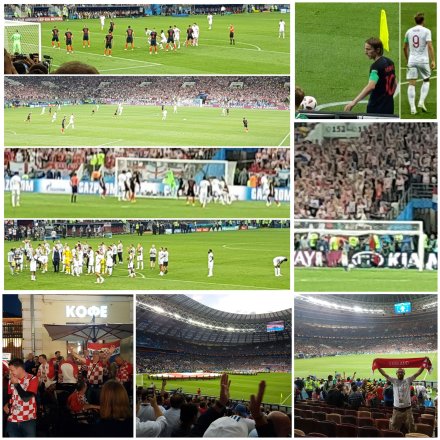
Trippier’s free-kick hit the back of the net against Croatia before the Three Lions had two more clear chances – one saved by Daniel Subasic, one missed by Jesse Lingard – as repeated direct attacks led by the pace of Sterling threatened to overwhelm Croatia. But as the pace of the game began to drop Croatia began to settle.
I was pleased England made it to half time, and hoped that the team might improve after the break. Southgate, having witnessed Eriksson’s uninspiring half-time team talk against Brazil in World Cup 2002, might be well placed to improve on it. Unfortunately however, Croatia were the side that improved and rapidly began to apply what seemed an unsustainable level of pressure.
Luka Modric continued to earn his player of the tournament award knitting together a side that effectively combined his fellow passing midfielders Ivan Rakitic and Marcelo Brozovic with the pace and skill of Ivan Perisic on the left flank and the power of Ante Rebic on the right flanking central striker Mario Mandzukic.
Right-back Sime Vrsaljko became increasingly influential, and defied rumours of injury to showcase his athleticism, alongside crossing ability reminiscent of his predecessor Darijo Srna. After receiving a quickly delivered diagonal pass from Rakitic, he crossed for Perisic whose high foot connected ahead of Kyle Walker to place the ball in the bottom corner.
Croatia continued to take charge and move the ball quickly from side to side, and on far too many occasions England’s defence were required to clear a ball into the box under pressure. Deep into extra-time they eventually failed, and Mandzukic’s finish spare the Three Lions what would have been an arguably undeserved penalty shoot-out against Subasic and his fearsome record at spot kicks.
Croatia fans I spoke to after the game had high praise for the effort of their whole team including left-back Ivan Strinic ‘who is normally sh*t’, and centre-back Dejan Lovren who had faced severe pressure early on in the match ‘Why are the English media always sh*tting on him – he has not done any mistakes I have seen all tournament!’. Fellow centre-back Domagoj Vida had withstood the additional test of facing repeated booing from Russian fans responding to comments he made about Ukraine in a video posted online.
Raheem Sterling had been vibrant in the early stages but Croatia had improved, and in the second-half he no longer looked capable of single-handedly posing the same threat on the counter-attack he once did. Southgate’s attempt at replacing him in a like-for-like substitution with Marcus Rashford was unsuccessful and England struggle to build moves on transitions deepened.
Southgate’s change was delayed and, given that despite the circumstances it did not attempt to either change the game’s pattern, or defend the flanks better by moving a forward out wide, arguably disappointing. I spoke to some England fans who felt he shared the blame with players who appeared content to reach the semi-finals rather than push for the final.
I am more sympathetic. The first-half’s goal, and the further chances that followed, indicated our potential to succeed. But ultimately I feel our dominant spell came too early for the team to adequately retain focus on the need to counter-attack well on the increasingly rare occasions when the ball was won.
Southgate had planned for an unusual 5-3-2 formation to make use of the abilities of the players available. Sterling’s dribbling skill and the finishing ability of Lingard and Dele Alli could be combined around the tournament’s top goalscorer Harry Kane in attacking situations. Pace throughout the side would help the team counter-attack on transitions to win set pieces, which had been identified as a particular strength owing to the delivery of Trippier and the aerial power honed in the Premier League of the likes of Maguire. Using only one wing-back on each flank for width, with other players more central and reinforced by using three centre-backs, would help move the ball across the pitch would help the team build attacks. The aim would be to effectively compensate for the comparative absence of midfielders with the creative and technical abilities to retain possession and control matches.
When this approach began to fail against Croatia, and belief in our ability to counter-attack with two strikers supported by two attacking midfielders became wishful thinking, I suspect no alternatives were attempted because no plan B had been prepared. I had heard from friends of members of the England camp as well as in the media of the efforts made to foster a positive environment in their training camp characterised by teamwork. Motivational infographics about the England team accompanied furniture designed to encourage players to sit together, with a non-alcoholic smoothie bar containing a cornucopia of ingredients for mental stimulation and to encourage creativity.
After what appeared an appalling mental collapse in Euro 2016, I can sympathise with Southgate focusing all the team’s efforts on making their new formation work as best as it could. Earlier in the tournament against Colombia, it also appeared to have been counter-productive to substitute Dele for the more defensive Eric Dier with the aim of playing more cautiously to maintain a lead.
Sadly, this inflexibility may also have reflected a lack of depth and a drop in quality between the starting XI, and players on the bench that Southgate felt unlikely to change the game enough to warrant the withdrawal of a more proven attacking weapon. Fans near me had called for the introduction of Ruben Loftus-Cheek, or Fabian Delph, with the aim of better retaining possession in midfield. But Delph played left-back last season, while Loftus-Cheek’s impressive display in an international friendly obscures his limited top-flight experience, largely in a direct Crystal Palace side and often out wide.
Losing control of games due to lack of quality in midfield has been a theme of the England team before, and a critical perspective could note our successes came only against lower-ranked teams and a Colombia side shorn of their star-player. But luck of the draw plays a big role in tournaments, and learning we can reach the semi-finals despite supposed weaknesses is a lesson we need to learn – and much of a young team may yet improve. Excessive pressure has allowed focus to be diverted from simply competing in matches too often. Southgate has shown us how to manage that hype, and finally led us to victory in a penalty shoot-out.
As I was told a fixture chart on the wall of the England camp said next to the World Cup knockout stages, there is “no limit on what we can achieve”.






 arthurvirgo
.svg)